Category Archives: walking

The Countryside

I love walking. I like a good stroll. I like hiking, whatever a hike is. I like the ordnance survey app, although the most recent update has made it a little more annoying. And walking apps – I have a simple one, but some friends have watches that send info to their phones about heart rate, distance walked, incline, blood pressure, even sleep, maybe their dreams. One friend told me his app is like a psychoanalyst – in the morning the app says ‘last night you dreamt of making a city that looked like a huge pizza – click ‘more’ to see an interpretation, but before you do please watch this short advert from Dominoes.’

My walking app is simple, bog standard, dream analysis free. Bog standard which is apt because last week I walked through a bog. My walking app says I average 7 km a day. I walk and walk. Most of it up and down my kitchen as I wait for some package to be delivered. Or to the local Coop to buy some discounted salad. There are tens of thousands of footpaths across the UK, some rural communities have a spiders web of them, some crossing private gardens, others through fields full of curious cattle. Ah! The countryside, rolling hills, pastures, a shepherd watching over the flock, sparkling rivers. Harvest, all is safely gathered in. Winter, the snow drifts over the hillside, a lost sheep wanders through the white landscape. Spring, lambs gambolling in fields, and summer meadows, those summer meadows of yore, an explosion of wild flowers, butterflies, birdsong. This – of course – is all in the imagination, the nation’s imagination. The reality isn’t so good.

Something like 8% of England is accessible to the public. And that 8% is disappearing. But please note: every freedom of access we, in this country, have been granted, has been through an act of parliament passed by a Labour government. Land in Scotland and particularly, some Scandinavian countries are far more open. Try walking anywhere in the United States – you’ll probably end up shot. And, if your survive, you can then wonder why the USA is experiencing a growing obesity epidemic.

Because of cuts to local authority funding, footpaths have not been maintained. Some local authorities used to have footpaths officers, a job I once quite fancied. They are long gone. The right of way is still on the Ordnance Survey map, but the stile is overgrown with blackthorn. You cannot get through. Or there are bulls in a field. Here’s a statistic I want to drop in: 11% of Woking Local Authority’s land is devoted to golf. I could say more about golf. But that’s all for now. Who owns the land? And why do they own it? Why does anyone own anything? 36,000 landowners (0.06% of the population) own half of the rural land of England. And you can imagine, many of those landowners have inherited it through generations. Maybe from an ancestor who was a henchman of the King, a loyal sidekick prepared to slaughter some rebellious countryfolk. Or, indeed, their money came from slavery. But, hey ho, an Englishman’s home is his castle.

In the last fifty years the global populaton of farmed animals has tripled whle those in the wild have declined by two thirds. 96% of mammals worldwide are humans and farmed animals. Only 4% are wild. 70% of all birds are farmed poultry. And what is nature? How is anything natural? The hedgerows? The few trees left in the corner of a a farmyard? The acres of land devoted to fir plantations? Are we natural? Are computers and satellites natural? The English countryside is very different from the the landscape of Wales and Scotland – the Celtic nations are mountainous. The name of the most mountainous part of England, Cumbria, shares its etymology with Cymru, the Welsh word for Wales. Cymru, comrade, friend. The English word Wales, incidentally, comes from the Saxon for foreigner. The bloody cheek! The Anglo-Saxons, those invaders, swarmed across England, looked towards the mountains of what is now Wales and thought, well, that’s a dark ,impenetrable and hostile land. Let’s stick to these low pastures, this Saxon land, this Angle-Land. And let’s call them foreigners! Pastures of cattle graze this blessed plot, this England. The romantic poets, Wordsworth, particularly, Coleridge, how they banged on about the beauty of nature, as did the Romans and the Greeks, the pastoral poets, Virgil and Horace and the rest of them. They have fed into this myth of the countryside and by way of the public school curriculum and more recently the grammar and secondary school curriculum, many of us have been fed the same myth. It is there, in most of us, this myth of the countryside, of nature. Yes, there are still some areas that are protected – but those areas are declining, and now stand, according to a report back in 2024, at around 3%.(This came from the Wildlife and Countryside Link.) The English countryside is a factory. A livestock factory. So you can see fields of crops, remember this: half the calories produced by UK farmers go to feed livestock. And while we’re on the subject, 75% of the world’s soy is used to feed livestock. The destruction of the rain forest, the annihilation of species is for meat. Soy from Brazil feeds the hens that fill the chicken factories along the river Wye which, as I write, is the subject of the biggest environmental lawsuit ever – 4,000 people have signed up to a class action against poultry producers and water companies. 23 million chickens – a quarter of the UK’s poultry production, are raised in the river’s catchment area. I’ve used the word ‘raised’ – that’s not the right word for the way these birds are treated. They are not raised, they are industrially processed. 51% of UK land is inhabited by livestock. 51% of the UK is a factory for milk and meat. The English countryside, said JRR Tolkein has ‘good water, stones and elm trees and small quiet rivers’. Tolkein’s Lord of the Rings has fed into the myth, as have thousands of clones of his world.

I began this podcast after Brexit. I could feel myself becoming more and more unhappy about living in the UK. So I thought, no, I am going to celebrate what I love. Now look what’s happened. I’m berating the country again. I love it and I hate it, but I will not stand by and watch it destroyed. I think people are waking up to the degradation caused by intensive farming, by bird numbers plummeting because of lack of habitat. Last week I took a short walk to my local supermarket, the route follows a river. As well as the usual suspects – gulls, crows, pigeons, I saw egrets, herons, cormorants, wagtails and dippers. I see kingfishers, their blue splash of colour almost unworldly, and, as I like to tell anyone nearby, the Greek for kingfisher is halcyon. Halcyon days. So maybe, just maybe, just maybe….halcyon days will, one day, return.

Maybe.

(This is a transcription of the episode ‘The Countryside’ on my podcast ‘These Weird Isles’ – available on all platforms).
Comments Off on The Countryside

Filed under blogs, food, nature, podcast, politics, These Weird Isles, Wales, walking

Kinder Scout

Kinder Scout is a mountainous plateau in the dark peaks of Derbyshire – a landscape populated with eerie wind sculpted boulders – some like the petrified forms of giants, others massive and layered, a city of the dead, a prehistoric world that must have perplexed and astonished generations.

Climb Kinder Scout and you are often in the clouds, as we were, in July 2023, a summer of rain. But when the clouds cleared the views were dizzying, to see so far, and so much, further peaks, pale and distant, the valley, villages, rivers, roads, a railway. The boulders on Kinder Scout take on many forms, of huge fists, monstrous mushrooms, lost peoples, alien civilisations. I hadn’t expected this, the weirdness of it, the wonder. Below us waterfalls cascaded into the valley and the world rolled away, it was breathtaking, magnificent and life enhancing. And it was not a straightforward climb, at least not from our starting point, Edale. It was a scramble up a steep ravine, or clough, of large boulders, this one called Grindstone. This meant taking extreme care, stepping from rock to rock, it would have been easy to lose concentration and slip. It’s not dangerous, but it’s not easy. But it is demanding, and it takes effort. To climb Kinder Scout up Grindstone Clough requires a certain level of fitness and persistence. You have to want to get to the top. Poor Cathy, my partner, half way up a well-meaning bloke behind us pointed out her boot was split, the heel detached. Cathy was, rightly, annoyed. What was the point, she said, in him telling me? It was worse, both boots had gone, both heels detached. But we had to press on, and we did, to the top, and the boots held. But later, they were given a funeral, fifteen years she’d had those boots, but Kinder Scout got the better of them.

Kinder Scout was the planned objective of the mass trespass of 1932, led by Benny Rothman, then just 20, a member of the Young Communist League, when groups of walkers gathered to protest against the landowners who, in 1877, had begun to close off the area, possibly to protect their grouse shooting an activity that took up, at most about two weeks of every year. In 1894 a railway station opened at Edale, giving Mancunians greater access to Kinder Scout. But in the 1920s more and more parts of Kinder Scout became closed off. The area had long been open to the public, most walkers were workers from Manchester who had, until then, enjoyed the free access, which now was being denied. Ewan McColl, folk singer, then 17 and plain Jimmie Miller, took part in the trespass, which probably never actually made it to Kinder Scout – they were waylaid by gamekeepers with dogs and eventually six of the young rambler were arrested and five imprisoned, the harshest sentence of 6 months.

The Manchester Guardian covered the trial, and this led to growing hostility towards the landowners. Eventually in 1949, the creation of National Parks – ten to begin with, but since then another five have been created. Although Kinder Scout is a symbol of the right to roam, the work of changing the law is probably more the result of the work of other groups – most significantly the Ramblers’ Association. The Sheffield Clarion Ramblers had made an earlier trespass, but this didn’t get the publicity – many rambling groups opposed the mass trespass of Kinder Scout, believing quieter methods would achieve access. Kinder Scout has become a symbol of the right to roam, but it was not a single blow dealt by the working class on landowners. It was not until 1958 that Kinder Scout became open to the public, and not until 2000, 68 years after the mass trespass, that the Crow Act – the countryside rights of way act, made provision for public rights of way further access to the countryside. And it should be noted all legislation to greater access to the countryside in England and Wales has come about under Labour Governments.

Even now only 8% of land in England and Wales is open to the public. In Scotland the access is far greater, where nearly all land is accessible to the public. Similarly people in some of the the Nordic countries, particularly Sweden, have almost complete access to the land – with laws stipulating that a hiker has a right to camp for one or two nights. There is a health crisis in the UK, with treatment for diabetes type 2, for example, being a huge drain on the NHS. And yet there is some evidence to show that exercise, and particularly walking, can lower the risk. So it’s not a huge leap to imagine that granting more open access to land could not only reduce the strain on the NHS, but save lives.

(this is a transcription of an episode of my podcast ‘These Weird Isles’ – available via Spotify, Soundcloud, Amazon, Apple etc.)

Leave a Comment

Filed under walking

The Hill of Dreams

Dominating the reclaimed marshlands of South Wales, Twm Barlwm stands as a barrier against potential invaders. I grew up below that mountain, in Newport, and every Good Friday a group of friends would undertake a strange pilgrimage to the top, an Iron Age hillfort, with its dome like construction at the summit.  We used to call it the twmp, or the pimple, but from a distance its not difficult to see the mountain as a reclining woman.  The pinnacle of Twm Barlwm is more like a nipple.

In The Silbury Treasure Michael Danes maintains that the Avebury stone circle in Wiltshire, and neighbouring Silbury Hill, the largest man made mound in Europe, is a Neolithic monument to procreation: the hill is a womb, the site, according to Dames, depicts a woman giving birth.

Neolithic peoples were the first farmers, and were well aware of the cycles of the seasons.  They sowed and they reaped, and the invention of agriculture gave rise to settlements of much greater complexity than those that preceded them.

Perhaps Twm Barlwm is a similar construction, on a gargantuan scale.  You can see the mountain from across the channel, in Bristol.   The Romans built a fort and amphitheatre at Caerleon, just a few miles to the south of Twm Barlwm.  I’ve often wondered if it was a base to lay siege to the mountain,  Twm Barlwm, Tump Bellum, hill of war.

I left Wales to go to art school in London.  There I discovered a tiny subculture of writers, poets and musicians who were admirers of the late nineteenth century Welsh mystic and author Arthur Machen.   Machen grew up in Newport, but his writing life did not begin until he moved to that same suburb I found myself, Acton.

His London Adventure is my favourite book of his, but here I want to concentrate on The Hill of Dreams, which begins with this wonderful sentence:

‘There was a glow in the sky as if great furnace doors were opened.’

The Hill of Dreams is Machen’s fantasy of his childhood, and the hill is, of course, Twm Barlwm.  It fictionalises Machen’s boyhood, much like my own, and his departure to London, where he attempts to make a living as a writer.

What pervades his books is a sense of the uncanny, of a belief that something more lies behind reality.  I read his books at a time when I was struggling to move forward.  On the evening I moved into a new room in a shared flat, it was a bitter winter, the heating failed, the pipes froze, as I was attempting to finish my first novel, a strong wind burst the window in my room, and when I reached down for my unpacked bag to find a jumper, I discovered the flat’s cat had pissed in it.

The cat’s owner had named it Crowley after the occulist, Aleister Crowley.  Crowley (the man, not the cat) was an admirer of Machen, but the admiration was far from mutual.  Aleister Crowley, I imagine, was the sort of man who would urinate in your bag and find it funny.  For weeks after I smelt of cat piss.  It felt like Crowley’s curse.

That first book was never published, but I did get a few encouraging responses form publishers.

Returning to Wales one spring, I decided to look for Machen’s childhood home, a rectory in Usk.  I went with a couple of friends.  It rained all day, and we got soaked.  It was April 1986.  A few days before the Chernobyl reactor in Ukraine exploded, nuclear radiation rained down over Wales, a ban was placed on sheep and cattle movement that wasn’t lifted for four years.  Again, I had been pissed on. But this time it was serious piss.

During those difficult years, the struggle to make my way in the big city, Machen’s books brought me great solace.  His trails were my trials, and his victories, I hoped, would soon be mine.

Unlike Machen, I returned to Wales, and to the hills: the Brecon Beacons, the Black Mountains.  I find great comfort in their vastness and beauty.  Those early years of living under the spell of a mountain still permeate my every waking moment.  From Twm Barlwm to Pen y Fan, the mountains of Wales are all hills of dreams.


1 Comment

Filed under childhood, mountains, Wales, walking, writers

Ramblings and Digressions

I found myself looking at antiques. In an antique shop. The owner, hidden behind a wall of stacked furniture, was observing me in a large mirror. At first I mistook his reflection for him, and nodded a greeting. When I realised I was addressing a reflection, I peered around the barricade and smirked. He responded with minimal interest. I was a prospective customer, but he could barely acknowledge me. I was interested in the Windsor chair, but it was too late, I couldn’t overcome my embarrassment now, and walked directly out. This was Abergavenny, a place I tend to look down upon.

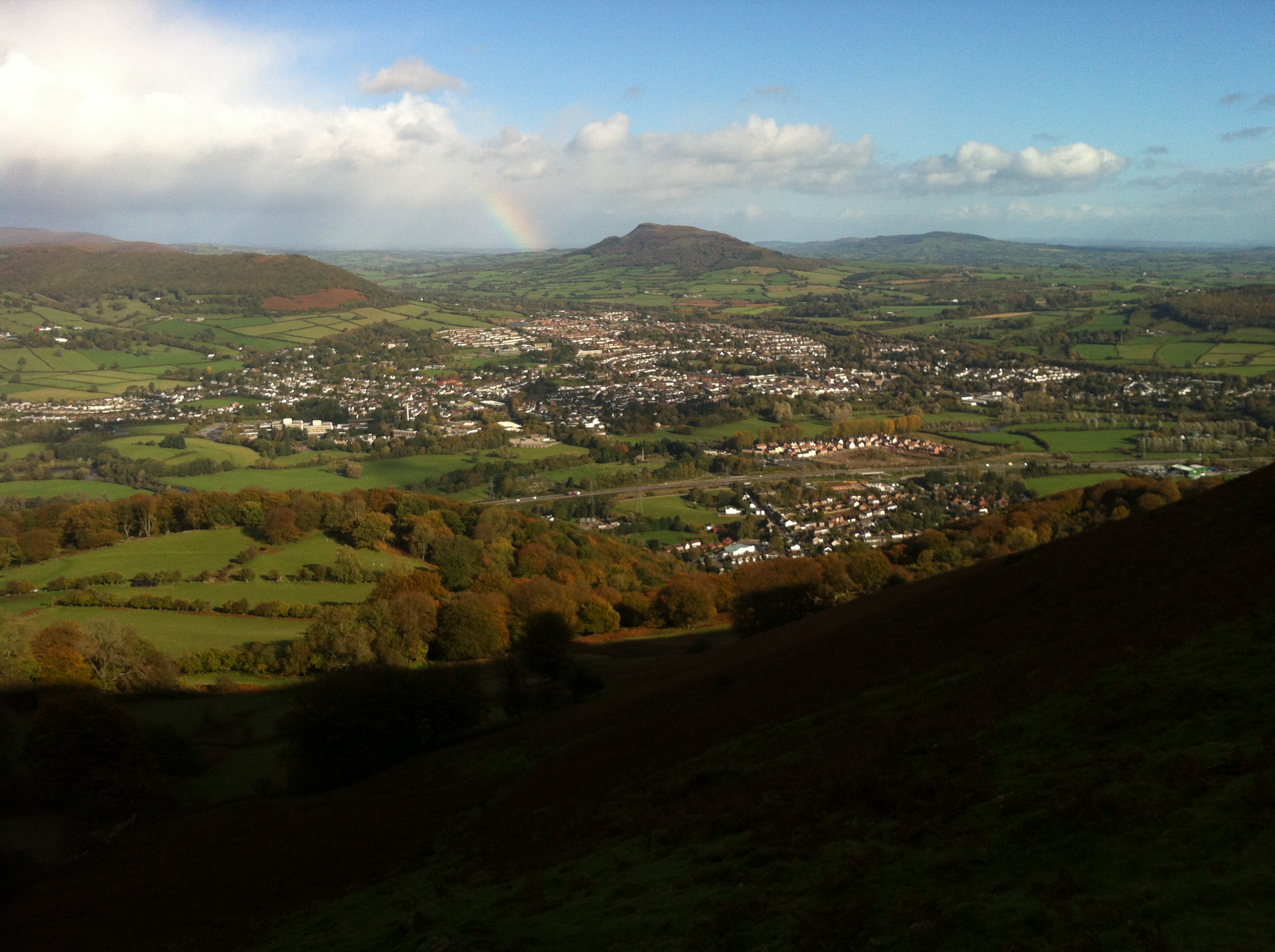
I look down upon Abergavenny from the three mountains that surround it. The Sugar Loaf, The Skirrid and The Blorenge. The last of these has an ascent so steep it is almost vertical. You climb on all fours, but standing up. The summit of the Blorenge can also be reached by road, which dilutes the achievement a little, but up there, with lungs screaming for air, this is what you get.

IMG_2565

The Skirrid can be seen at the foot of the rainbow, and at the foot of the Skirrid, is The Walnut Tree Inn. I love The Walnut Tree.

I fell over on the Skirrid, a long time ago. I thought I had broken a rib. On presenting myself at A&E  at the Royal Gwent Newport, and complaining of chest pains, I was immediately rushed into a cubicle and sensors placed on my chest.

Only the night before I had been drinking in the Church House, a pub at the Handpost, just outside Newport. The Slowboat Takeaway is just up the road, and above that is a small flat where Green Gartside used to live. I used to see Green wandering the pavements. He was quite famous then, and I never understood why he had chosen to live back in Newport. I don’t think he ever wrote a song about Newport, or the Slowboat.

I was drinking alone  in the Church House, a pub near the Handpost, just outside Newport, when a bloke slumped down next to me and asked if I could buy him a drink. He was in a bit of a mess, pissed, but seemed  good company.  I bought him a pint, and he began telling me how hard his life was, how he couldn’t hang on much longer. He told me he was doctor at the Royal Gwent, and although I had no reason to doubt him, I did. He looked bedraggled, and after all, he did ask me to buy him a pint.

I’m covered in sensors, wondering why no one will just take my word for it, that this isn’t a heart attack, I’ve just done something to my rib, but the ECG is blipping away and the doctor rushes in, unshaven, squitty eyed, and it’s him, the guy I was drinking with night before. He didn’t recognise me, of course. I was going to tell him about our encounter, but decided not to.

The rib took months to heal, and I can’t think of the Skirrid without thinking of that fall. The day of my fall I’d climbed the hill with my parents, neither could manage it now, they are both approaching ninety, and live just around the corner from the Church House.  I was there just last week. My mother is very unwell, and my dad cares for her full time. He’s usually very perky, and full of rambling, digressive stories. But last time I saw him he looked weak and frail and was sorry for himself.  It was his 87th birthday.

“I’ve lived long enough,” he said. I gave him a hug when I left. It was hard.

But today I’m in Abergavenny, making my way to the car park after walking out of the antique shop. I get in the car, drive home. On the radio Iain Sinclair is talking about WG Sebald. I love both writers. Sebald’s Austerlitz is one of my favourite books.  I prefer it to The Rings of Saturn, which many people consider his masterpiece. Sebald was a walker, and his books are often ramblings in both senses. Sinclair spoke of Sebald devotees who try to retrace his steps and fail. Sebald was a storyteller, Sinclair reminds us.

Leave a Comment

Filed under blogs, books, mountains, Wales, walking, writers