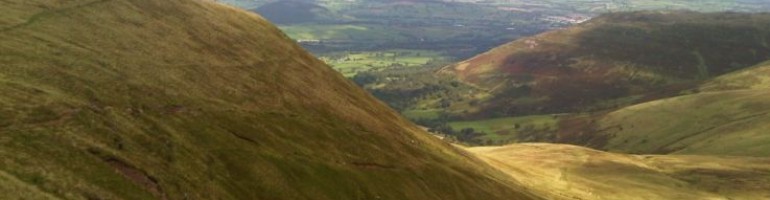
Bradnor Hill overlooks the small Herefordshire market town of Kington, on its summit, just before the golf course, there’s a white house that plays a small part in the history of these weird isles.
A golf course is full of holes. The fields and hills surrounding Kington are pocked with rabbit holes, and at the core of this story is a musical hole, a hole where there should be a note, and that eerie missing note helped build a billionaire’s empire.
In late 1973, musician Mike Oldfield moved to that white house on Bradnor Hill to escape the media lens. Oldfield, until then, had been a quiet, clever guitarist, taking up bass to play with songwriter Kevin Ayers. At the same time as Oldfield was playing bass and making a little money as a theatre musician, he was working on his own project, a full length instrumental, Opus One. Richard Branson, who had made a small fortune with his magazine, Student, now owned Manor Studios in Oxford, and gave Oldfield a week’s studio time to re-record Opus One. This became better known as Tubular Bells and was the first release on Branson’s Virgin Records. It sold over eighteen million copies. This gave Branson wealth with which he went on to found other businesses – Virgin Megastores, Virgin Money, Virgin Rail, Virgin Atlantic and Virgin Galactic.
The success of Tubular Bells meant that Oldfield could concentrate on his own music: he moved to the white house on Bradnor Hill, known as the Beacon, and began writing the follow up, which was to be titled Hergest Ridge. The house was soon converted into a sophisticated recording studio. Hergest Ridge (it is pronounced ‘hargest’, with a hard ‘g’) lies like a sleeping dragon opposite Bradnor Hill. It seems very likely that Oldfield would lose himself up there, the cover of that second album features the ridge, an Irish wolfhound and a model glider. I climbed the ridge only a few weeks ago, on the summit is a weird and incongruous circle of monkey puzzle trees. The ridge rises in England and descends into Wales. England remains verdant and pastoral, good farming country. Look across into the mountains of Wales and you come to understand why the border is here – Wales looks dark and impenetrable, its land not as amenable to growing crops.
Oldfield was still young when he moved to the Beacon, and he was very reclusive, he didn’t enjoy fame and was also dealing with inner turmoil. His mother had poor mental health, would fall ill and die in the time he was beginning work on his third album, Ommadawn, also recorded at the Beacon. Although Oldfield was reclusiv, he loved music too much to not play in public and is known to have performed at nearby Penrhos Court at a time when Welsh Monty Python member Terry Jones owned a share in a microbrewery based there. Led Zeppelin and Queen were also known to have dropped in. Oldfield didn’t play for money, but for wine.
The two albums Oldfield recorded while living in Kington are very romantic works. There is a strong thread of folk music but also the heart aching melodies of English composers like Vaughn Williams. After completing two albums in Kington, Oldfield left the Beacon, he moved, first to Buckinghamshire, then Gloucestershire, Ibiza, Monaco, and now he is resident in Nassau, in the Bahamas. Oldfield and Branson’s fortunes were propelled by Tubular Bells and by its use in William Friedkin’s 1973 demonic film, The Exorcist.
Tubular Bells‘ central and weird motif is a melody that superficially seems to repeat the same phrase, but in every other repeat one note is added on. That first phrase contains the hole that is filled on each second repeat. The listener can never relax, that central motif is the key to the work, and the key that turned the lock on a treasure chest which eventually would help send Richard Branson into space. Technically we have three bars of seven beats and one of nine, but in practise it is just one note removed, then added on. That one dropped note is like a hole in the rhythm, it could be irritating, but instead it is eerie, like a foreboding, the melody is continually unfinished, then finished and then unfinished again, creating a distinct sense of unease. You can’t march to it, you certainly can’t dance to it. What you can do is feel a little spooked. Could one dropped beat do so much? One missing beat that launched a thousand trains, planes, a hot air balloon and a space ship? The introduction to Mussorgsky’s Pictures at an Exhibition alternates between five and six beats to a bar, but it is extremely slow, it doesn’t conjure anything like the same mood as Tubular Bells, and it isn’t supposed to. Musicians like messing with time signatures, modern classical composers can’t resist it, and prog rock bands of the 70s liked to show off some knotty time changes, but odd time signatures feature less often in what could be regarded as a superficially simple songs – Nick Drake’s River Man uses five beats in a bar, (like Dave Brubeck’s Take Five and Gustav Holsts’ Mars – Bringer of War); Peter Gabriel’s Solsbury Hill has seven beats in a bar, Bjork’s Moon begins with seventeen beats in a bar – but it is rare for a big hit song to change time signature too often – the introduction to Tubular Bells changes tempo every other bar. Oldfield was as young as sixteen when he came up with that motif, he obviously recognised its magic: he built a fifty minute piece around it. But he surely can’t have imagined how it would seep into the consciousness of a generation, transform his own life, and help build the business empire of British billionaire Richard Branson.
(this is an adapted transcription of my podcast These Weird Isles)